Raul John Aju: The Kerala Government-School Teen Who Talked AI With Putin
Raul John Aju: The Kerala Government-School Teen Who Talked AI With Putin
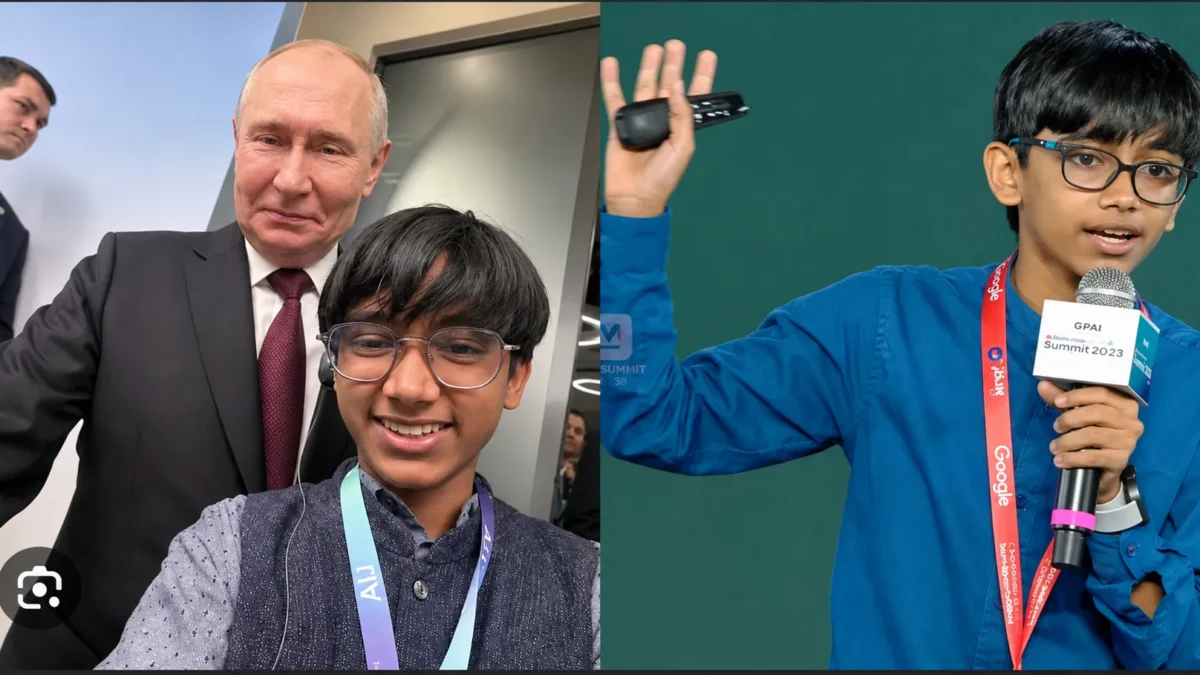
Raul John Aju is a 16-year-old from Kochi, Kerala, who studies at a government school and runs his own AI company. On 26 November 2026 he sat down with Russian President Vladimir Putin at AI Journey 2026 in Moscow and argued that children should treat AI the way they treat a calculator: learn the basics first, then let the machine multiply what you can already do.
People in India know him as the “AI Kid of India”. After the Putin selfie went around social media, a lot of readers started asking the same three things: who is this boy, what exactly did he say, and how does a government-school student end up in that room? This post answers all three, and then looks at the Kerala public education system behind his story.
Raul John Aju at a glance
Raul John Aju is 16 and lives in Kochi, Kerala. He studies in Plus Two (commerce) at the Government Higher Secondary School, North Edappally, and is known as the “AI Kid of India”. He founded AI Realm Technologies, a startup with about 15 staff and more than 15 AI tools, including RESQ AI (also called NyayaSathi), MeBot, ZapGap, FeedFye and ThinkCraft. His family comes from Ezhamattoor near Kozhencherry in Pathanamthitta, and the exchange with Putin at AI Journey 2026 in Moscow was filmed on 26 November 2026.
What did Raul John Aju say to Putin?
The session was part of AI Journey 2026, where Putin and Kazakhstan’s President Kassym-Jomart Tokayev met young people working in AI and robotics. Putin raised a worry that parents and teachers everywhere share. If a chatbot hands you the answer in two seconds, will students stop memorising anything and lose the habit of working through a hard problem on their own?
Raul did not argue for banning AI, and he did not argue for letting kids outsource their homework to it either. His position, as The Sunday Guardian reports it, was that students should learn to work with AI responsibly.
The calculator analogy, in plain words
Think about how maths is taught. A child spends years adding, subtracting and multiplying by hand. Calculators arrive much later. Nobody calls that unfair; it is how you make sure the child understands what the machine is doing.
Raul says AI should follow the same order. Get the foundation first. After that, AI becomes a multiplier. It can explain a concept three different ways, give examples at your speed and quiz you at midnight, which a single teacher with 40 children in a room simply cannot do for everyone. He also talked about teaching maths through games and short videos matched to how each child learns.
Putin reportedly liked the idea, praised him for encouraging young people to build their own solutions, and tied his work to India’s “Make in India” push. They took a selfie, and the rest is internet history (India TV News).
Is Raul John Aju really a government-school student?
Yes, and this is the detail most coverage skims past. Several outlets, including ETV Bharat, Onmanorama and the Deccan Chronicle, put him in Plus Two commerce at the government higher secondary school in North Edappally. An earlier profile in Global Indian described the school as the Government Vocational Higher Secondary School in Edappally, so you will see slightly different names. It is the same area of Kochi and the same kind of school: free, state-run, with no entrance fee.
In that profile he said the school’s relaxed attitude to extracurricular work gave him room to experiment. That matters more than it sounds. A teenager who spends nights building a legal-help bot needs a school that does not punish him for it.
One honest caveat: one student does not prove a whole system. But it does knock down the assumption that this kind of story needs an expensive private school and big-city coaching.
How did a Kochi teenager build an AI company?
The timeline, pieced together from Global Indian, Onmanorama and UN News:
- Around age 9: he starts teaching himself AI and making videos, using editing tools his father (who worked in tech) gave him.
- Age 12: builds MeBot, a humanoid robot, for a school science fair.
- Early teens: ships tools like RESQ AI (tells you which laws apply in an emergency and connects you with a lawyer), ZapGap, and FeedFye.
- 2026: speaks at the India AI Impact Summit in New Delhi, meets UN Secretary-General António Guterres, and opens a UN-organised panel on AI and child safety.
- Government work: reported to have advised the Kerala and Dubai governments on AI in public services.
- Now: runs AI Realm Technologies and pays his father, who joined the company, a reported Rs 2 lakh a month.
Numbers about his reach do not agree. Global Indian says over 140,000 people trained, Onmanorama says nearly five lakh, and in the UN interview he said his free ThinkCraft courses have reached more than seven million. Treat all three as self-reported or press-reported, not audited. When he told UN News what matters most in the age of AI, his answer was to “be as human as possible”.
Kerala’s government school system, explained simply
If you are outside Kerala, the state’s public schools can look like a black box. Here is how it actually works.
Three kinds of school, one syllabus
Kerala has government schools, aided schools (privately managed, salaries paid by the state) and unaided private schools. Government and aided schools are free for students. Most follow the state syllabus prepared by SCERT, with the SSLC exam at the end of Class 10, and then Higher Secondary (Plus One and Plus Two) where students pick science, commerce or humanities. Raul is at that last stage, in commerce.
KITE: the technology wing
Kerala Infrastructure and Technology for Education, called KITE, sits inside the General Education Department. Its biggest early push, reported in 2018, turned more than 40,000 classrooms in state-owned schools into hi-tech classrooms with a laptop, projector and speakers each (Gulf News). Many Kerala teachers learned to teach with projectors well before the pandemic forced everyone online.
Little KITEs: where students build things
This is the part that probably matters most for kids like Raul. Little KITEs are student-run IT clubs inside schools, covering animation, programming, robotics, hardware and more. They are described as the country’s largest school ICT club network. At the 2026 state camp, 204 students were picked from 78,336 applicants across 2,248 school units, and the clubs are being extended from Classes 8 to 10 up to Classes 5 to 12. Projects on show included an underwater rescue prototype, a glove that turns sign language into speech and a Malayalam care bot for elderly people (Lokmat Times).
Robotics and AI reach every Class 10 student
In January 2026, KITE started robotics workshops for roughly 4.5 lakh Class 10 students in government and aided schools. Groups of four or five share an Arduino kit and learn block-based coding, tied to the updated IT textbook (Onmanorama). The state has also announced plans for its own AI engine for schools and AI projects for high-school students (Careers360).
How Kerala scores nationally
India’s Performance Grading Index for school education runs on 70 indicators and 1,000 points. In 2025-26 Kerala moved up to the Prachesta-1 grade with 716.8 points, second among states behind Punjab, and got the top grade in Access and in Teacher Education and Training (The News Minute).
It is not a perfect system. Infrastructure gaps, teacher workload and uneven learning outcomes exist here as everywhere. The direction, though, is clear: put technology and hands-on learning inside the free school, not behind a fee.
What parents and teachers can take from this
Say your child is in Class 8 and has started using a chatbot for homework. A calculator-style rule works well at home: attempt the problem on paper first, then ask the AI to check the working or explain where you went wrong. For revision, ask it to quiz you instead of summarising the chapter for you. And if the school has a Little KITEs unit or any science club, push your child to join. Building a small, ugly project teaches more than a month of watching tutorials.
Frequently asked questions
Who is Raul John Aju?
Raul John Aju is a 16-year-old self-taught AI developer and entrepreneur from Kochi, Kerala, known as the “AI Kid of India”. He founded AI Realm Technologies and met Vladimir Putin at AI Journey 2026 in Moscow.
How old is Raul John Aju?
He is 16, according to reports from November 2026.
Which school does Raul John Aju study in?
He studies in Plus Two (commerce) at the Government Higher Secondary School, North Edappally, Kochi, a Kerala government school.
What did Raul John Aju discuss with Putin?
They discussed AI in education. Raul argued that students should master basics first, like with calculators, and then use AI as a personalised learning tool rather than a replacement for thinking.
What is KITE in Kerala?
KITE (Kerala Infrastructure and Technology for Education) is the technology arm of the Kerala General Education Department. It runs hi-tech classrooms, teacher training and the Little KITEs student clubs.
Is education free in Kerala government schools?
Yes. Government and aided schools in Kerala do not charge tuition fees.
More on AI and education
Want more plain-English AI explainers? Browse our Artificial Intelligence section or the latest Tech News.